Wednesday, January 12, 2011

Explore Los Angeles via hidden staircases and urban hikes

Silver Lake Reservoir

From the Los Feliz Ledger:

Thanks to the path around the Silver Lake Reservoir, it is so much easier to “walk the lake.” The opening of the meadow will soon add a scenic loop that will open up views of Silver Lake’s hills.  When some out-of-town visitors recently asked for a Silver Lake walking tour, I gave them the fifty-cent tour—an easy amble along the west Silver Lake Boulevard side of the reservoir path and a detour to Neutra Place, with a quick look at the Cove Avenue stairs, and a short break and cup of chai at LA Mill.

Silver Lake resident and writer Charles Fleming has formalized those kinds of tours, adding much historic information via his recently published book Secret Staircases: A Walking Guide to the Historic Staircases of Los Angeles. A detailed guide to 42 walks from Pasadena to Santa Monica, more than half the guidebook looks at stairs and points of interest in Silver Lake, Los Feliz, Hollywood and Echo Park. Most of these public staircases were built in the late 1920s to connect residents in hillside neighborhoods to streetcar lines. Fleming also leads hikes once a month. The next scheduled walk is February 6, 2011. Sign up for the email alert.

“People who come on the walks are doing a lot of things,” Fleming said. “They are into exercise, they want to explore their city and are fascinated by architecture and history,” he said. Each of his tours starts at a cafĂ© or restaurant and is typically an hour-and-a-half loop; the number of staircases involved determines the hike’s difficulty. “People are touched to find out about these public pathways that harken back to another time,” Fleming said.

The Los Angeles Conservancy conducts eight guided walking tours each month principally of downtown’s historic core and one in nearby Angelino Heights. Open to the public, reservations are suggested.
Bradbury building interior, downtown Los Angeles

I have my own downtown historic walk I give visitors beginning with breakfast at the Nickel Diner, then traversing the Old Bank District to the Bradbury Building, a walk-through the Grand Central Market then a ride on Angel’s Flight railway up to the California Plaza with a look at MOCA and the Walt Disney Hall.
Walking the L.A. River, Red Car River Park, Atwater

Walking path along the L.A. River, Atwater
Also worth exploring: the Atwater side of the Los Angeles River where a paved path extends both north and south of Los Feliz Boulevard. Close to Los Feliz Boulevard, plaques suggest yoga poses to try while stopped in one of several pocket parks planted with native sycamores. And for those needing more inspiration, writer Eric Hiss has put together dozens of urban hikes in his book: City Walks Los Angeles: 50 Adventures on Foot.

Wednesday, December 1, 2010

Silver Lake's Michael Maltzan Architecture at the Museum of Modern Art

Exhibition entrance at MOMA

From December 2010's Los Feliz Ledger:

Silver Lake-based architect Michael Maltzan’s project for downtown’s Inner-City Arts is front-and-center at New York’s Museum of Modern Art’s (MOMA) exhibition Small Scale, Big Change: New Architectures of Social Engagement. Running now through Jan. 3rd, the show presents 11 architectural projects from around the world that bring well-designed buildings to underserved, often impoverished communities. Although limited in scale and budget, the projects highlighted have had positive wide-reaching effect in terms of social, political and economic transformation.

The Inner-City Arts project began in 1993; Maltzan was commissioned to remake a former auto body shop on Skid Row into a new home for an after school arts program. He incorporated the body shop’s roll-up doors, making an aesthetically pleasing space that allows seamless movement between inside and outside. For the children who come to the center, the space’s openness is in direct contrast to the more institutional type buildings they typically occupy throughout the day. The building is purposefully all white and meant to enforce a sense of optimism and possibility for the future.

Over time, the now one-acre complex (a micro-city of creativity) has evolved from its modest beginnings. At MOMA, the exhibit maps the project’s evolution and includes a full-size model of the current building, design elevations and a wall-sized architectural photograph that shows Inner-City Arts in context, just east of downtown—an unlikely location for ambitious architecture of this caliber.
“It’s in an area of the city, which is anonymous for most people,” said the architect.

One of the tenets of modern architecture is the idea that architecture can advocate and partner in social change. Maltzan believes that while architecture should aspire to be progressive, the question of change is more complex.  “Change at times is good and is at times bad but it is always inevitable. It takes ambition, focus and hard work to make society in a more progressive way; architecture can be an agent in that way,” he said.

Maltzan and his firm have also received acclaim for two other socially conscious projects built for Los Angeles’ Skid Row Housing Trust, and the firm is now in the final stage of drawings for a third mixed-use effort for the Trust, the Star Apartments. For those that may miss the exhibition in New York, a comprehensive view is available on the museum’s website.


Tuesday, November 2, 2010

Project Restore to renovate Barnsdall Park's Hollyhock House

Restoration work on Frank Lloyd Wright's Hollyhock House

My article from November 2010's Los Feliz Ledger:

EAST HOLLYWOOD—By the end of 2010, a long-planned restoration of Hollyhock House should get underway.

A public/private partnership, “Project Restore” is the non-profit organization that will oversee construction at the house that includes improvements to the historic garage and seismic retrofitting and foundation work at the house as well fixes to leaking roofs. The $4.359 million allocated for improvements is a combination of state funds, a grant from the National Park Service via Save America’s Treasures program, seismic bond funds and Quimby fees from the city. These funds are not from the city’s general fund, thus the project is not subject to the same budget cuts facing the other facilities in the park.

Per Kevin Jew, project manager for Project Restore, the Hollyhock House garage will be upgraded first so that it can serve as an on-site construction office.  Already, initial steps have been taken at the house including the positioning of steel posts (photo above) that will anchor a temporary roof above the patio just off the living room. Portions of the roof have been sheathed in metal to prevent further water damage; those roofs will also be fixed.
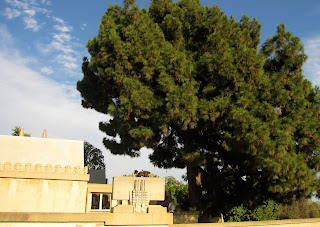
Say goodbye to the 80+ year old Canary Island pine at Hollyhock House
One major and highly visible step will be the removal of a stately Canary Island pine on the house’s western facing side.  The tree’s roots are damaging retaining walls, according to Jew. Curator Jeffrey Herr confirmed that he is committed to keeping the house open for public tours, which may be re-routed somewhat for public safety’s sake.  The renovation will not be completed until late 2013. Summertime’s Friday afternoon wine tasting events, in conjunction with Silver Lake Wine, should not be impacted.

Remaining in a state of limbo: restoration work and the re-opening of Residence A, for decades home to adult art classes. An historic structures report was completed by the city in 2009 that estimated the cost of structural maintenance and restoration at $1.9 million. Funds for that restoration project are not yet in place.

Tuesday, September 28, 2010

[Out there] At Baja's End: Las Ventanas al Paraiso (Los Feliz Ledger)

Las Ventanas: View towards the Sea of Cortez

 A Treat for the Spirit and the Senses

CABO SAN LUCAS–A lizard skittered across the pebbly path just outside my room. I considered the movement a farewell after four grand days at Las Ventanas al Paraiso, Cabo San Lucas, Mexico. The fact that I took notice of the reptilian salute explains much about my visit to this resort so well located in the desert landscape that one becomes steeped in connectedness (and reconnecting with oneself). I was so relaxed and happy that I relished the details of every last moment: the azure sea, the frigate bird circling above, the lizard crossing my path and the goodbye wave from the staff lined up at the resort’s entryway as we drove away along the date palm tree-lined drive.

Land's End: Cabo San Lucas
 Los Cabos has a well-earned reputation as a touristy party spot. The once remote fishing village has been remade into a string of fashionable resorts, condominiums, and shopping areas—the two cabos being Cabo San Lucas and San Jose del Cabo. But at Las Ventanas, on the resort corridor, you’re removed from the tequila-infused mayhem and honky-tonk of downtown Cabo San Lucas. One of the nicest resorts I’ve ever been invited to, Las Ventanas was designed to take full advantage of its stepped-down hillside location: the resort is set into the hill, with a hidden system of passageways underneath for staff.  You’ll never see a maid’s or room service cart; nothing ordinary spoils your views of the sea and brilliant white clouds, save for the edge of the resort’s infinity pool that melds right into the sea.

In early summer, the humidity had not set in, so although it was warm, a dip in the pool took the heat off.  Each pair of low-rise lounges has their own umbrella—a pool butler will quickly adjust the slant to keep the sun at bay.  Oh yes, they are pool butlers as well a friendly chap who’ll clean your sunglasses so they are transparent. If you’ve visited Mexico, you’ll know that service can be very friendly and welcoming, at Las Ventanas, they’ve made an art of it, which quite frankly makes for a very pleasant experience when everyone you deal with has a genuine smile on their face.

Sunset at Las Ventanas
Remarkable attention to detail extends to every corner of the property whether it is the raked coarse sand that edges walkways and grounds planted with native cactus and agaves or the raked beach and small thatched huts that shade hammocks or the small gifts at turndown like a mini straw doll magnet. 

Lovely but wild Sea of Cortez
Contrasting with the resort’s cocooned environment is the natural wildness of the location:  the rough waters out front means that ocean swimming requires a short walk to a nearby cove while rays and sharks are easily spotted offshore. Swells mean a pleasant boat ride to a snorkel spot may engender seasickness (I’m a firm believer in Dramamine) or an encounter with a stinging jellyfish. The same trip yields underwater views of the Sea of Cortez’s vibrant eco-system:  I snorkeled amongst a multitudinous school of amberjack following a current. And the sun is brutally direct—sunscreen is a must and sunburns a common souvenir.

Tibetan bowls are part of a meditative spa ritual
Of special note: the compact spa at Las Ventanas which has an outdoor shower (a wonderful treat), an intricately tiled steam room and in-ground soaking pools (one hot, another cool).  I took part in a unique meditation ritual: Tibetan bowls are played musically (the sound is unmistakably restful), sage is burned and ancient chants and lute music fills the air.  I felt incredibly relaxed as I lay under the latilla (thatched roof), isolating each sense before a restorative massage.

And that’s what you’ll find: clean, windswept ocean breezes, the brilliant sun, the warm waters, the kicky margaritas (made with fresh lime juice with Centanario reposado tequila), the rooms flawlessly decorated in artisan-made furniture, and the ocean-to-table Baja-Mex cuisine, all combine to entice and re-awaken the senses.

Las Ventanas' executive chef Fabrice Guisset
Baja-Mex cuisine reinterprets Mediterranean dishes, like ratatouille, with indigenous Mexican ingredients such as Serrano chili. I spent a pleasant morning watching Fabrice Guisset, the resort’s classically trained executive chef, demonstrate and serve several of the resort’s signature dishes in the open-air demonstration kitchen, set in the green herb garden. Guisset does his best to make the most of the Baja peninsula’s produce and exquisite seafood, as well as the talents and traditional recipes of his Mexican-born staff.

A profusion of rosemary plants heat up in the sun, scenting the air as I learn how to make guacamole properly and a lighter-than-air snapper with gremolatta. Much of the fresh fish served at Las Ventanas is line caught and brought in by local fisherman.  Red snapper, Wahoo, and striped sea bass are so fresh—you can often see the fishing boats just offshore—that their pure flavors hardly resemble stateside versions. A simple fish taco is delight because the fish not only just out-of-the-sea but it’s also expertly cooked over a wood fire at the resort’s Sea Grill. (For more on Las Ventanas' cuisine and chef's garden as well as a delicious guacamole recipe, check out my post "A Chef's Garden at Land's End" for GardensToTables.com).

Lamp lighting at day's end.
On the last day of my visit, I took a yoga class on the beach. We looked out to the cerulean blue sea to center ourselves, our instructor taught the class in four languages: charmingly blending her instructions in Spanish, Hindi, French and English. As the class lay on mats in the sand for our last moments of meditation, small songbirds chirped sweetly, as if on cue.  And why wouldn’t they? Even the birds and lizards must realize they’ve found paradise.

Excerpted from the Los Feliz Ledger desktop edition 9/1/10.

Thursday, September 23, 2010

Resnick Pavillion at Los Angeles County Museum of Art opens soon

Resnick Pavilion designed by Renzo Piano

Opening to the public on October 2, 2010, Los Angeles County Museum of Art's (LACMA) ultra-contemporary $53 million, 45,000 square foot Lynda and Stewart Resnick Exhibition Pavilion was unveiled to Los Angeles' media today.

An Olmec basalt rock monument


Three exhibitions fill the space. Olmec: Colossal Masterworks of Ancient Mexico features monumental prehistoric stone sculptures as well as smaller objects from Mexico's earliest civilization.


An Olmec Colossal Head 1200-900 BC


Fashioning Fashion is a rare chance to look into history's closet and has nearly 160 exquisitely made examples of  clothing and accessories from intricately embroidered silk and muslin dresses to tailored waistcoats to a rather sexy c. 1900 leather corset accessorized with fetish boots.


18th Century-style fashionistas


Eye for the Sensual: Selections from the Resnick Collection has more than 100 fine pieces of furniture, sculpture and decorative art (such as a pair of Art Deco lamps made from bronze cobras) that span centuries and reflect the couple's eclectic taste. The building's numerous skylights face north, so the entire space is flooded with natural light. The palm garden and surrounding landscaping is by Robert Irwin who also designed the Getty Center's landscaping. Check out the impressive new space, BCAM and LACMA's vast holdings for free during the inaugural weekend of October 2-3. Ticket info here.


LACMA's new Resnick Pavilion


Los Angeles County Museum of Art
5905 Wilshire Blvd.
Los Angeles, CA 90036
323-857-6000

Thursday, September 2, 2010

Los Angeles' Natural History Museum 1913 Building restored

Restored facade at L.A.'s Natural History Museum: the Eagle sculpture soars again

I've been to L.A.'s Natural History Museum many times: the 1913 Building was the home of the infamous Discovery Room--a creepy crawly extravaganza known as the bug room at my house.  $100 million dollars later, it's now been redone and houses the new interactive and very modern Age of Mammals exhibition which manages to encompass 65 million years of history in one room.

Age of Mammals at the Natural History Museum
As I wrote in September 2010's Los Feliz Ledger: Among the highlights of the restoration is the return of a picturesque terra cotta eagle sculpture, with 7-foot wingspan, that is dramatically perched above the building’s oft-photographed facade. Guided by 24 pages of original drawings, the architecture and engineering team brought back architectural details, such as the 30 arched windows and glass roof in the wing that holds the Age of Mammals.  The restored windows remarkably brighten the space, giving it a very contemporary feel. Newly opened within the historic structure, the perennially popular Age of Mammals was re-designed, with up-close displays behind glass panels that give visitors a way to connect with the deep past. The room that has numerous interactive touch screens, 38 mammal skeletons and digital shorts that illustrate concepts like planetary geology and human evolution, all designed to make science accessible. More than 130 specimens came from the La Brea Tar pits; the suspended whale skeleton above helps put human size in perspective.

Art glass by Judson Studios tops the domed ceiling of the 1913 Building   

Look up to see the original, stunning art glass ceiling, now brilliant and luminescent once again. Created by Highland Park’s Judson Studios, the restoration of the rotunda’s domed opalescent art glass ceiling was overseen by David Judson, great-grandson of the initial artist.

And there's still more to come at the museum: new landscaping and entrance will face Exposition Boulevard and a new Age of Dinosaurs Hall. All scheduled to be redone by museum's 100th anniversary in 2013.

Monday, July 26, 2010

Silver Lake Walking Man's local memorials

An iconic fixture on local streets, Walking Man (aka Dr. Marc Abrams) died last week. Sunday's memorial walk in his honor was covered in the New York Times. The story includes an interview with muralist and artist Nicholas Gagliarducci.  (I previously wrote about the mural in May 2009). As the New York Times reports: The mural depicts Dr. Abrams in his trademark light green shorts, reading a newspaper and headed past historic Los Angeles buildings and parts of the city long-since built over.

“There was a sadness about him that might have triggered the old L.A. scene I painted,” Mr. Gagliarducci said. “These parts of our city are things that have disappeared, so it’s like he’s there walking through history.”

There's another Walking Man portrait in the painted mural on the Micheltorena St. Elementary school's Sunset Blvd. facing wall (above). Very saddened by his passing are the youth in the neighborhood who have seen the Walking Man go by their entire lives.

Walk in peace, dude. You will definitely be missed.